Rental of cottages / Alquiler cabañas

| Los Pinos & Los Fresnos | Los Limoneros | El Sauce | El Cisne | Historias | Servicios | Contacto | Home |
 Aladdin's cave
La cueva de Aladdino
My sister Sheila's stories!
Los cuentos de mi hermana Sheila!
Childhood Memories
Recuerdos de la Infancia
Visitor's Book
Comentarios de nuestros huespedes
Childhood Memories
The most vivid and nostalgic memories I have are of short periods lived on the farm. These periods were either weekends or holidays which we always spent there. We used to go there all the year round but the memories which most persist in my mind are those of summertime.
Summertime on the farm was blazing sun, vivid colours and sleek horses. The early morning was chasing through the wet grass, whooping and with arms held out after the horses. They were always let loose in large fields and were terribly difficult to catch. Once cornered against a fence they stood quivering and panting and it was a matter of approaching them slowly, with crooning noises towards a sort of centre of gravity point in their bodies where if they swayed backwards or forwards one could move in accordance and stop them from plunging away in triumph. I was always the catcher, my sister always took up the rearguard and much later she confessed she was terrified of me and the horses. The horses because they payed no attention to her and me because of the abuses I used to shout at her!
But once on the horses' backs we were good friends. We would ride for miles and hours, like wild creatures, bareback and only wearing a pair of shorts. We explored and made our own the countryside within a radius of 30 kilometres . And it is very varied countryside –a sample of a great many geographical categories; beaches, forests, dunes, lakes, lagoons, rivers, coves, hills and meadows. Each place was named and baptized as we discovered it, my sister usually chose the names because she did a lot of reading.
In fact, we took the names of two cowboys that appeared in popular comics of those times. My sister was the Lone Ranger and her horse was called Silver, in spite of it being a very red-looking animal. I was Tom Mix on his faithful steed Tony. We didn't stop at the names, we spent many a day trying to jump off our horses while they were galloping and land on our feet, but usually landed in an ignominious position, on our backsides, or on our elbow or on our stomach with the accompanying effect of being winded, which was not too pleasant. I also broke my nose one day. No, we never became proficient at the landing stage of Cowboydom.
These are amusing incidents which can be told; what I can't describe adequately are the infinite quantity of little facets of experience: the smell attached to each different place, the stillness in certain woods, the deep shady colours and the bright sunlit ones, the calling of wood pidgeons on a hot summer afternoon……
Many, many more of these memories find no verbal expression but just exist in my mind. Perhaps I am very lucky to be very much, physically, in contact still, with all this scenery of my youth.
Recuerdos de la Infancia
Los recuerdos más vívidos y nostálgicos que tengo son de períodos cortos transcurridos en la granja. Estos períodos eran fines de semana o vacaciones que siempre pasábamos allí. Solíamos ir todo el año pero los recuerdos que más persisten en mi pensamiento son los del verano.
El verano en la granja significaba sol ardiente, colores fuertes y lustrosos caballos. La mañana temprana eran persecuciones a los caballos a través del pasto mojado, gritando con los brazos extendidos. Se soltaban siempre en potreros grandes y era muy difícil agarrarlos. Una vez acorralados contra un alambrado, se paraban temblando y jadeando y había que acercárseles lentamente, con suaves murmullos hacia una especie de centro de gravedad en sus cuerpos, donde si se movían hacia atrás o hacia delante, uno podía acompañar el movimiento e impedir que se escaparan triunfantes. Yo era siempre la que los agarraba; mi hermana siempre tomaba la retaguardia y mucho después, me confesó que estaba aterrada de mí y de los caballos. De los caballos, porque no le prestaban atención y de mi por las cosas horribles que le gritaba!
Pero una vez sobre los lomos de los caballos éramos buenas amigas. Cabalgábamos kilómetros y horas, como criaturas salvajes, en pelo, solamente usando un par de pantalones cortos. Exploramos y conquistamos un territorio dentro de un radio de 30 kilómetros . Y es una campiña muy variada –un muestrario de muchas categorías geográficas; playas, bosques, dunas, lagos, lagunas, ríos, ensenadas, colinas y praderas. Cada lugar al ser descubierto, era nombrado y bautizado, mi hermana generalmente elegía los nombres ya que leía mucho.
De hecho, tomamos los nombres de dos vaqueros que aparecían en revistas populares de la época. Mi hermana era el Llanero Solitario y su caballo se llamaba Plata, a pesar de ser un animal de aspecto muy colorado. Yo era Tom Mix en su fiel corcel Tony. No eran sólo los nombres; pasamos muchos días tratando de saltar de nuestros caballos mientras galopaban y de caer paradas, pero generalmente aterrizábamos en una posición ridícula, o sobre nuestros traseros, o sobre el codo o el estómago con el efecto secundario de quedar sin respiración, lo cual no era muy agradable. Una vez también me rompí la nariz. No, nunca nos volvimos expertas en la etapa del aterrizaje en Vaquerolandia.
Estas son anécdotas divertidas que pueden ser contadas; lo que no se puede describir adecuadamente son las infinitas pequeñas experiencias: el olor que acompaña cada lugar diferente, la quietud de algunos bosques, lo profundo y sombreado de algunos colores y lo intenso y soleado de otros, el llamado de las palomas en los montes una tarde calurosa de verano...
Muchos, muchos más de estos recuerdos no pueden expresarse verbalmente, solamente existen en mi pensamiento. Quizás soy afortunada de estar todavía, físicamente, muy en contacto con todo este paisaje de mi juventud.
Aladdin's cave
By late afternoon I had to have everything ready. There were 17 Aladdin lamps to be prepared, each an eternal fixture of lagoon life, but imported, rather surprisingly it now seems, from Nashville, Tennessee. They were kept in a special cupboard away from harm, in the one dark corridor of sleepy house, together with my birth shoes in their cardboard box. Depending on where Mum and Dad had spent the last part of the evening, there were lamps to collect for the evening ritual. First, every one of them had to be filled carefully with kerosene, nearly full, without spilling any. (Here's something a bright boy can do). Then, gently remove the glass chimney, and put it slowly down on the table without damaging the frail cotton filament. Pull out the perforated metal centre from the wick, and then trim it with the not very effective special circular trimmer. Put the chimney back again, checking to see if the cotton filament had survived. If not, take a new one from the cupboard, stiff with some sort of starch, unwind the glass chimney and with steady neurosurgical precision, put it into position. Mark that lamp down for special attention, since the first burn would be pretty explosive, as all the starch went up with a whoosh. Take each lamp, unlit, to the place it would occupy for the evening, except for those four which would go onto high wall brackets, which one put close by on a table for lighting. Get the one storm lantern, fill with kerosene, and put near the kitchen where Cook could use it. Then go out for the last of the evening, to enjoy the brief twilight, which was not, we were told, the proper extended twilight people had in England, and the greater twilight Grandpa enjoyed in Edinburgh.
When it was finally almost dark, I went in to light the lamps. The matches were not proper wooden English matches, but feeble local waxed straws with a red phosphor head which came apart as you struck them. Gently remove the glass chimney, light the wick all round, making sure it was a just the right height. Put the glass chimney back on and twist it safely closed. Wick too low, flame goes out. Wick too high, filament would blacken up. Just right, the filament would glow weakly, and the lamp could be left for the glass chimney to heat up gently. Too fast, and it would crack. Once I had lit five lamps I would walk them slowly to their final positions and then run back to light another five. Eventually I would have each in place. Then I'd move quickly to the high technology of the storm lamp. Pump up the pressure with the inbuilt pump. Get some blue meths, (such a nice smell, so comforting) and pour it into the small metal basin round the nozzle. Light the meths and see the ethereal flame, like a small Christmas pudding. Go off to check the Aladdins. Come back just as the meths was just about to finish and release the pressure, so that the pumped kerosene sprayed out furiously through the hot nozzle onto the flame, to create a blinding white light, and the hissing of an unexploded bomb, which it was, particularly when cook rested it on the hot wood stove, so that she could see how the food was coming along.
As the family came in we could turn up a few of the Aladdins, and then we got the loveliest light in the world, warm and bright, the conical cotton filament glowing on all sides. The whitewashed brick walls bounced back the light onto our faces, and shone up to the dark raftered thatch. When Dad came in he would inspect the light, put an Union cigarette in his mouth and hold it just at the rim of the glass chimney, like a circus assistant awaiting a sharp shooter's bullet. In an instant the cigarette would glow bright red, he would puff contentedly and we could settle down for the evening. Two of the lamps had white porcelain shades, and after dinner we did our reading round those, silent and bright on the dining table.
My labour made night time light precious, because the lamps were dangerous, fragile, and needed frequent attention. Even now, when I flick an electric light switch, I miss the glowing mantles of the paraffin lamps in Sleepy House.
In winter my other task was to set the fires, filling each grate with pine cones, and putting eucalyptus logs on top. One match on a scrap of newspaper would be enough to start the blaze. Apart from the dining room we'd light one in Mum and Dad's bedroom and one in ours. Granny Thompson would put us to sleep by telling us stories and, when young, by scratching our heads. We were on bunks and then, still hearing the grown ups talking next door, could look up the receding perspective of the rafters to the dark underbelly of the thatch, where the spiders lived, and then down to the warm dying fire in the grate.
La cueva de Aladino
Para la tardecita debía tener todo pronto. Había que preparar 17 lámparas Aladino, cada una parte de la vida eterna de la laguna, pero, ahora parece increíble, importadas de Nashville, Tennessee. Se guardaban a salvo de accidentes en un ropero especial, en un oscuro corredor de la somnolienta casa, junto con mis zapatos de recién nacido en su caja de cartón. Dependiendo de dónde Mamá y Papá habían pasado las últimas horas de la noche, había que buscar las lámparas para su ritual del anochecer. Primero, cada una de ellas debía ser cuidadosamente llenada de kerosén, casi al tope, sin derramar nada. (Esto es algo que un niño inteligente puede hacer). Luego, suavemente retirar la chimenea de vidrio, y ponerla despacito sobre la mesa sin romper el frágil filamento de algodón. Sacar el centro de metal perforado de la mecha y recortarla con el no muy efectivo recortador circular especial. Colocar la chimenea nuevamente, verificando que el filamento de algodón hubiese sobrevivido. Si no, tomar uno nuevo del ropero, rígido por algún tipo de almidón, desenroscar la chimenea de vidrio y con firme precisión de neurocirujano, ponerlo en posición. Marcar esa lámpara para prestarle atención especial, porque la primera encendida sería bastante explosiva, ya que todo el almidón se quemaría en un instante. Llevar cada lámpara, apagada, al lugar que ocuparía al anochecer, excepto por las cuatro que irían en estantes altos contra la pared y que debían colocarse en una mesa cercana para ser encendidas. Tomar el farol, llenarlo con kerosén y dejarlo cerca de la cocina donde pudiera ser utilizado por la cocinera. Entonces salir por el resto del atardecer a disfrutar del breve crepúsculo, que no era, nos dijeron, el crepúsculo largo que la gente tenía en Inglaterra, ni el más prolongado crepúsculo que Abuelo disfrutaba en Edimburgo.
Finalmente, cuando era casi de noche, entraba a prender las lámparas. Los fósforos no eran los auténticos fósforos ingleses de madera, sino las versiones locales; débiles pajitas enceradas con cabeza de fósforo rojo que se desprendía cuando los encendías. Cuidadosamente sacar la chimenea de vidrio, prender la mecha todo alrededor, asegurándome de que la altura fuese la correcta. Colocar la chimenea de vidrio otra vez y enroscarla firme y seguramente. Mecha muy baja, se apaga la llama. Mecha muy alta, el filamento se ennegrece. En el punto justo, el filamento daría un resplandor pálido y se podría dejar la lámpara calentando suavemente la chimenea de vidrio. Demasiado rápido y se rajaría. Una vez que hubiese encendido cinco lámparas, las llevaría lentamente a sus posiciones finales y luego correría para encender otras cinco. Finalmente tendría cada una en su lugar. Entonces me movería rápidamente hacia la alta tecnología del farol. Bombear la presión con la bomba interna. Conseguir alcohol azul (qué olor tan rico, tan tranquilizador) y volcarlo en el pequeño recipiente de metal alrededor de la boquilla. Encender el alcohol azul y ver la llama etérea, como una pequeña torta de Navidad. Ir a controlar las Aladino. Volver justo cuando el alcohol azul se estaba por consumir y bajar la presión de manera que el kerosén bombeado surgiera furiosamente a través de la boquilla caliente hacia la llama, creando una luz blanca cegadora con el silbido de una bomba sin explotar, que es lo que era, particularmente cuando la cocinera lo apoyaba en la cocina a leña caliente, para ver cómo se estaba cociendo la comida.
Cuando la familia entraba, prendíamos algunas de las Aladino, y entonces teníamos la luz más linda del mundo, cálida y brillante, el filamento cónico de algodón iluminando todo alrededor. Las paredes de ladrillos encalados reflejaban la luz en nuestras caras e iluminaban el oscuro quinchado. Cuando Papá llegaba, inspeccionaba la luz, ponía un cigarrillo Unión entre sus labios y lo sostenía justo en el borde de la chimenea de vidrio, como un asistente de circo esperando la bala del tirador experto. En un instante el cigarrillo resplandecía rojo fuerte, él pitaba contento y nos instalábamos para la noche. Dos de las lámparas tenían pantallas de porcelana blancas y luego de cenar, leíamos sentados alrededor de ellas, silenciosas y luminosas sobre la mesa de comedor.
Mi trabajo convertía la luz nocturna en algo precioso porque las lámparas eran peligrosas, frágiles, y necesitaban frecuente atención. Aún hoy, cuando prendo una lámpara eléctrica, extraño los mantillos brillantes de las lámparas de parafina en la Casa Somnolienta.
En invierno mi otra tarea era prender las estufas, llenando cada hogar con piñas y poniendo troncos de eucaliptos encima. Un fósforo en un pedazo de diario era suficiente para encender la llama. Además de la estufa del comedor, prendíamos una en el dormitorio de Mamá y Papá y una en el nuestro. Abuela Thompson nos hacía dormir contándonos cuentos y, cuando éramos chicos, rascándonos las cabezas. Teníamos cuchetas y entonces, todavía oyendo a los grandes hablando en la habitación próxima, podíamos ver hacia arriba la perspectiva de las vigas que se alejaban hasta la oscura panza del quincho, donde vivían las arañas, y luego hacia abajo al tibio fuego muriendo en el hogar.
My sister Sheila's stories!The first since I started the blog and don't worry for nowadays no more hordes of flies!
This is back in the 1950s.There were sooooo many flies! Swarms of black flies! Very uncomfortable black flies! You couldn't eat out, for your elbows would be flapping to get rid of them and they would calmly walk all over your food as you tried to eat it. It was repulsive... Even more repulsive the "tragamoscas" that Daddy had found to solve the problem! They were large large jars of glass about 50 cms. tall and with a special screw on top that allowed smells to waft out and flies to pour in... but they couldnt get out. What was put in there? Water and rotten lumps of meat... which rotted all the more in the sun and heat, and the smell and sight of them was horrific. You would have to be very careful to sit above wind of them...
Sheila told me that once some chinese people came to visit, and they asked her what was produced on the farm. Her reply was "FLIES", they stared at her and were silenced but apparently impressed!
So there you are, Daddy in the '50s and '60s had tons of chickens stuffed into sheds... (that is another story) and he also had the dairy... where there was plenty of manure and logically... PLENTY OF FLIES!!!
Los cuentos de mi hermana Sheila!
Los primeros desde que empecé el blog y a no preocuparse que hoy en día ya no hay más moscas!
Esto fue allá en 1950. Habían taaaaantas moscas! Enjambres de moscas negras! Moscas negras muy incómodas! No se podía comer afuera, porque estarías a los codazos tratando de librarte de ellas quienes muy tranquilamente caminaban por encima de tu comida mientras tratabas de comer. Era repugnante... Aún más repugnante el “tragamoscas” que Papá había encontrado para solucionar el problema! Eran frascos muy grandes de vidrio de alrededor de 50 cm. de alto con un tornillo especial arriba que permitía que salieran olores y entraran las moscas... que luego no podían salir. Qué se ponía ahí? Agua y pedazos de carne podrida que se pudría más todavía al calor del sol. El olor y la vista eran horrendos. Había que tener mucho cuidado de sentarse a favor del viento...
Sheila me contó que una vez vinieron unos chinos de visita y le preguntaron qué se producía en la granja. Su respuesta fue “MOSCAS”, se la quedaron mirando en silencio pero aparentemente muy impresionados!
Así que ahí tienen, Papá en los años 50 y 60 tenía toneladas de pollos en cobertizos... (esa es otra historia) y también tenía el tambo... donde había montones de bosta y lógicamente... MONTONES DE MOSCAS!!!!
Visitor's Book
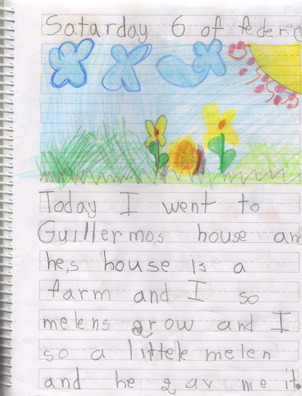
Saturday February 6th 2010 Today I went to Guillermo's house and his house is a farm and I saw melons grow and I saw a little melon and he gave me it!
Comentarios de nuestros huéspedes
Sabado 6 de fedrero Hoy fui a la casa de Guillermo y su casa es una granja y bi milones cresiendo y bi un milensito y el me lo regalo.